
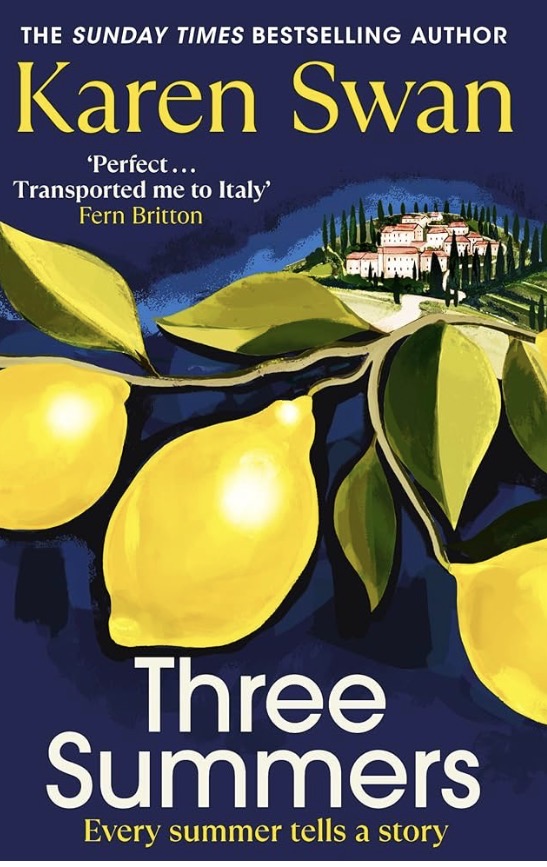
The publisher’s presentation
1950’s Italy
1957: The summer of innocence
Amongst the lemon trees, Rafaella Parisi impatiently waits for the summer visitors to arrive in her small fishing village on the coast of Puglia. She may be dating Fon Giannelli, but there is one person she longs to see: Cosimo – son of the wealthy Franchetti family.
1958: The summer everything changes
After a devastating accident at the lavish Franchetti villa, Rafa makes a vow that changes the course of all their futures . . .
1961: The summer they meet again
When Rafa and Cosi’s worlds collide, Rafa faces an agonizing choice. Is she willing to risk the life she has for the future she once dreamed of?
My reading experience
This book is a great Karen Swan! And the cover is beautiful.
The story is original and strong. It starts as a lovely story of friends spending the summers together in a small village in Puglia, Italy. A wealthy family mixing with the locals. But as the friends grow into adolescents and young adults, their relationships change. There is attraction, love, rivalry, friendship and envy, which all come together when one particular dramatic event changes their lives for ever. Behind what looks like a regular group of people, there is a lot of hidden aspects of their lives, which reveal themselves with dramatic consequences.
As usual, Karen Swan thoroughly researches her books, and this one is no exception. The setting and historical background have been beautifully well researched and rendered by the author. Reading the book is an immersive experience in la dolce vita, the Italian lemon groves, the sandy coves, the clear water swims after a ride on the vespa or the cinquecento and the village life of a small Italian port in the summer. The traditions, celebrations and social habits are interestingly woven into the story, from weddings to pasta making, major festivals and the big tuna fishing mattanza . The historical background also features strongly in the plot, which illustrates the changes in the economy in Italy in the timeframe of the book, the times of the Italian Economic Miracle. In Puglia, this period was also marked by a shift from traditional, low-level rural crime to the structural beginnings of organised crime, which features prominently in this story.
I enjoyed again the beautiful writing of Karen Swan, sensitive, descriptive, with the right pace and with this constant attention to detail about the realities she is writing about. It is a balance that makes her book stand out and that makes her one of my favourite authors.
Thanks to Netgalley and Harper Collins for giving me the opportunity to review this novel. All opinions are my own.
 Valerie is reading
How about leaving a comment and getting the discussion going?